

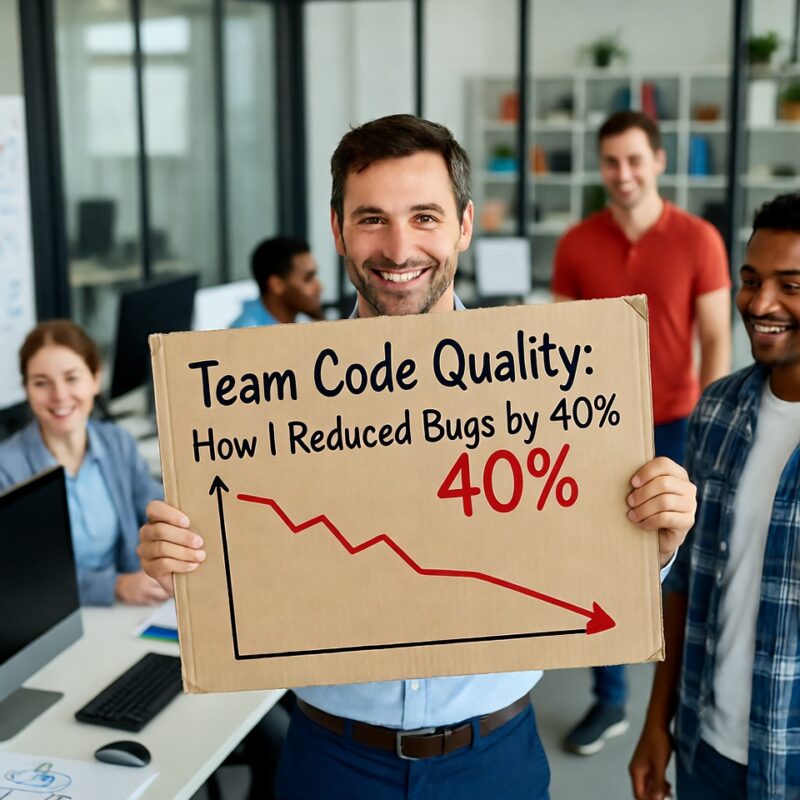
During a code review last year, I noticed our team was spending more time fixing bugs than building features. Our codebase had become a tangled web of inconsistent patterns, making even simple changes risky and time-consuming. If you’ve ever inherited a legacy system or worked on a rapidly growing codebase, you know the frustration. This article shares my experience leading a code quality initiative that transformed our team’s productivity, reduced bugs by 40%, and made our codebase a joy to work with. You’ll learn practical strategies for improving code maintainability that you can implement in your own team.
The Problem: When Technical Debt Becomes Critical
Our team was building a React-based SaaS application that had grown from a proof-of-concept to serving thousands of users. The initial “move fast” mentality had left us with significant technical debt. The symptoms were everywhere: inconsistent naming conventions, components with 500+ lines of code, and test coverage below 30%. New developers took weeks to become productive, and senior engineers were constantly putting out fires.
Before the Initiative
- PR reviews took 3-5 days on average
- 40% of sprint time spent fixing regressions
- Component reusability below 15%
- New features often broke existing functionality
Team Impact
- High frustration and context switching
- Fear of refactoring critical paths
- Difficulty onboarding new team members
- Decreasing velocity with each sprint
“We weren’t just maintaining code—we were navigating a minefield every time we shipped a change. The team’s morale was suffering, and our velocity was declining despite adding more developers.”
— Senior Frontend Developer on the team
The Turning Point: Making the Case for Change
The breaking point came when a seemingly simple feature update caused a critical production bug that took our entire team 36 hours to resolve. I realized we needed systemic change, not just another quick fix. I started by collecting data to build my case:

I analyzed our last six months of Jira tickets and found that 62% of our engineering time was spent on bug fixes and maintenance rather than new features. I presented this data to our engineering manager along with a proposal for a “Code Health Sprint”—a focused effort to implement standards and tooling that would pay for itself within three months.
- ROI Calculation: Showed how reduced bug-fixing time would increase feature development capacity
- Risk Mitigation: Highlighted how consistent patterns would decrease production incidents
- Team Empowerment: Framed it as an investment in developer happiness and retention
The Solution: A Multi-Layered Approach
Rather than trying to fix everything at once, I proposed a phased approach focusing on the highest-impact changes first. We started with automation and consistency, then moved to architecture and testing.
Phase 1: Code Consistency
- Implemented ESLint and Prettier with team-agreed rules
- Created shared component library with Storybook
- Established naming conventions and folder structure
- Added pre-commit hooks for automatic formatting
Phase 2: Architecture & Testing
- Introduced design pattern documentation
- Implemented comprehensive testing strategy
- Created code review checklist and standards
- Added automated code quality metrics to CI/CD
The key to successful implementation was making the new standards easy to adopt. We integrated everything into our existing workflows—developers didn’t need to learn new tools or change their habits significantly. The pre-commit hooks automatically formatted code, and our CI pipeline would fail builds that didn’t meet our quality thresholds.
Overcoming Resistance: The Human Element
Not everyone was initially enthusiastic about the changes. Some senior developers felt the new rules were restrictive, while others worried about the time investment. I addressed these concerns through education and incremental adoption.

I organized weekly “pattern workshops” where we discussed different approaches and collectively decided on standards. This created buy-in rather than imposing rules from the top down. We also started recognizing “quality champions” who exemplified good practices, turning skeptics into advocates.
- Education First: Ran workshops on why certain patterns improved maintainability
- Pilot Program: Started with a non-critical module to demonstrate benefits
- Data-Driven Wins: Shared metrics showing reduced bug counts and faster development
- Peer Recognition: Highlighted team members who contributed to code quality improvements
Measurable Results and Lasting Impact
Within three months, the initiative delivered concrete results that exceeded our expectations. More importantly, it created a cultural shift where code quality became everyone’s responsibility.
Quantitative Results
- Production bugs decreased by 42%
- PR review time reduced from 5 days to 1.5 days
- Test coverage increased from 28% to 75%
- New developer onboarding time cut by 60%
Qualitative Improvements
- Team confidence in refactoring increased significantly
- Code reuse across projects became common practice
- Developer satisfaction scores improved dramatically
- Architecture decisions became more intentional
“The most surprising outcome wasn’t in the metrics—it was in how the team’s mindset shifted. We went from fearing changes to confidently improving code, knowing our safety nets would catch issues early.”
— Engineering Manager
Conclusion: Your Code Quality Journey Starts Small
Improving code quality across a team isn’t about grand, sweeping changes—it’s about consistent, incremental improvements that compound over time. The experience taught me that technical challenges are often human challenges in disguise. Success came from combining the right tools with team buy-in and clear communication of benefits.
Whether you’re dealing with a legacy codebase or trying to maintain quality in a fast-growing startup, start with one pain point. Maybe it’s implementing a linter, creating a shared component, or establishing code review guidelines. Measure the impact, share the wins, and build momentum. Code quality isn’t a destination—it’s a continuous journey that pays dividends in team happiness, product stability, and business outcomes.
